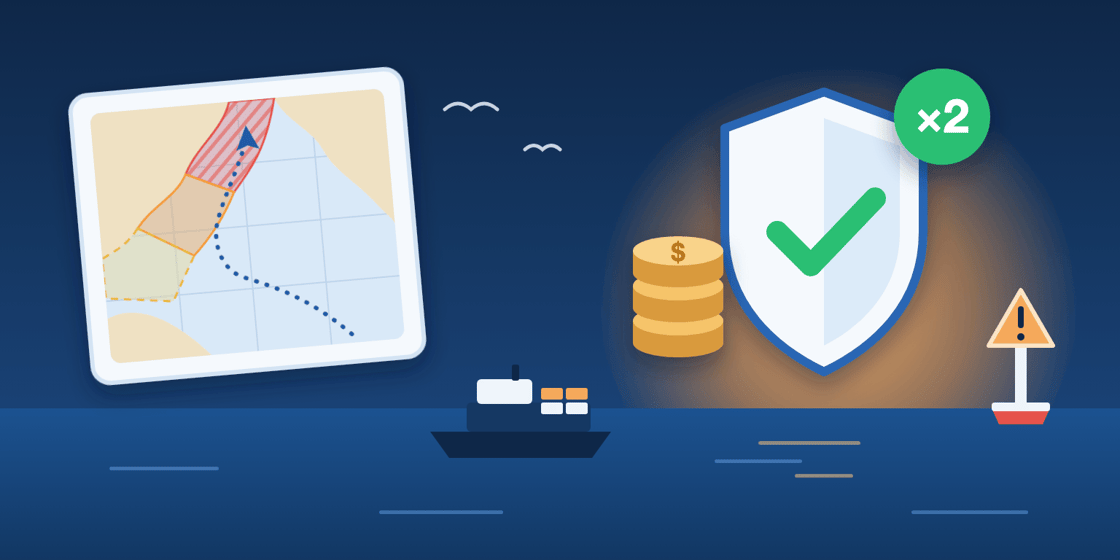
ITF and IBF warlike areas 2026: war bonus and right to refuse
Current IBF and ITF warlike areas: Red Sea, Persian Gulf, Black Sea, Israel. The bonus you are owed and how to refuse the voyage without losing your job.
On this page
- ⚓ Who draws the map and whether it applies to you
- 🗺️ Three levels of risk
- 📍 The map as of October 15, 2026
- 💵 How much it comes to
- 🙅 How to refuse the voyage the right way
- ✅ If you stay: what to check
- 🧾 Five questions to ask the crewing agency before you sign
- 🆘 Contacts to save on your phone
- 🔄 The list changes: check the date
The contract says “worldwide trading.” Mid-contract the voyage orders arrive: load at Ras Tanura, then Novorossiysk, bunkers at Fujairah. Most seafarers simply sail on, unaware that on a ship covered by an IBF or ITF agreement they are owed a bonus equal to their daily basic wage for every one of those days, and that they can refuse the voyage altogether, go home at the company’s expense and collect two months’ basic wage on top.
Below is the full map as the IBF and ITF agreed it on October 15, 2026, the money in plain numbers and what to do, step by step.
⚓ Who draws the map and whether it applies to you
The areas are designated by two bodies, and which list applies depends on the agreement your ship is covered by:
- IBF agreement. The International Bargaining Forum is where ITF unions and shipowners negotiate together. Its joint Warlike Operations Area Committee decides which waters are dangerous, for how long, and what the crew gets there.
- ITF agreement (TCC). On ships under the ITF standard Total Crew Cost agreements, the areas are designated by the ITF itself. Today its list matches the IBF map zone for zone.
To find out which one you have, ask the crewing agency before you sign: “Is the vessel under an IBF or ITF agreement?” On board, look for the ITF Blue Certificate on the notice board. The list of designated areas must be annexed to the collective agreement and kept on board where the crew can read it: you have the right to ask the master for it.
If the ship has neither agreement, none of this applies automatically. You get only what is written in your own contract, a national union agreement or the owner’s policy. Some of them copy the IBF terms, many do not. Read the war risk clause before you sign, not after the orders arrive.
🗺️ Three levels of risk
The agreements set three levels. What you get depends on the level, not on how frightening the news looks.
| Level | Can you refuse? | Bonus | Death and disability compensation |
|---|---|---|---|
| Warlike Operations Area | Yes: repatriation at the company’s cost plus 2 months’ basic wage | 100% of the daily basic wage, minimum 5 days, then for each additional day | Doubled |
| High Risk Area | Yes, on the same terms | 100% of the daily basic wage for the actual days of stay or transit | Doubled |
| Extended Risk Zone | No | 100% of the daily basic wage only on the day the ship is attacked | Doubled, if it happens on the day of an attack |
Three more rules that crews rarely hear about:
- You must be told in advance. If the ship is bound for, or may enter, a warlike or high-risk area, you are entitled to know at the time of assignment. If it becomes known at sea, you must be told immediately.
- Security is not optional. In warlike and high-risk areas the operator is obliged to arrange protection equivalent to ISPS Level 3: security personnel or systems that make the ship less vulnerable. In extended risk zones the measures must go beyond the Best Management Practices (BMP) level.
- Captivity does not end your job. If you are taken captive through piracy or hijacking, your employment is protected, inside the designated areas or anywhere else in the world.
📍 The map as of October 15, 2026
| # | Area | Level | Since | Valid until |
|---|---|---|---|---|
| 1 | Yemen: 12 nm off the mainland coast and all Yemeni ports, except the Maritime Security Transit Corridor (MSTC) | Warlike | Mar 1, 2018 | Nov 23, 2026 |
| 2 | Southern Red Sea south of 16°24′N, Bab el-Mandeb, the Gulf of Aden with the MSTC, the coasts of Djibouti and Somalia | Warlike | Mar 19, 2024 | Nov 23, 2026 |
| 3 | Sea of Azov and the Kerch Strait north of 45°03′N | Warlike | Nov 1, 2023 | Nov 23, 2026 |
| 4 | Northern Black Sea: from the Ukraine–Romania border to 45°10′N 031°00′E and 45°21′N 032°30′E | Warlike | Mar 1, 2022 | Nov 23, 2026 |
| 5 | All ports of Ukraine | Warlike | Mar 1, 2022 | Nov 23, 2026 |
| 6 | Black Sea south of areas 3 and 4 and the Crimean coast, down to the line 43°25′N 039°55′E – 44°04′N 031°24′E – 44°44′N 031°11′E – 45°12′N 029°41′E | High risk | Nov 1, 2023 | Nov 23, 2026 |
| 7 | Persian Gulf, the Strait of Hormuz and the Gulf of Oman north of 24°00′N, with all ports, terminals, anchorages and inland waterways | Warlike | Mar 6, 2026 | Nov 5, 2026 |
| 8 | Southern Gulf of Oman: south of 24°00′N, up to the line on a bearing of 035° from Ra’s al Hadd light | Extended risk | Mar 2, 2026 | Nov 5, 2026 |
| 9 | 12 nm off the coast of Israel and Lebanon | Extended risk | Mar 13, 2026 | Nov 5, 2026 |
| 10 | Israeli Mediterranean ports and Lebanese ports: alongside and during pilotage | Extended risk, level 2 | Apr 3, 2026 | Nov 5, 2026 |
What that means in real port calls:
- Red Sea. Jeddah, Port Sudan and the Suez Canal are outside the list. The warlike area begins at 16°24′N, roughly at the Saudi–Yemeni border, and covers everything south of it, Djibouti included. A plain transit of Bab el-Mandeb earns the bonus for five days, even if you are through in a day.
- Persian Gulf. Every port of the Gulf is a warlike area: Ras Tanura, Jebel Ali, Dammam, Kuwait, Basra, the Iranian ports. The popular bunker anchorages of Fujairah and Khor Fakkan lie north of 24°00′N, so they count too. The status applies at anchor and “all fast” alongside, not only underway.
- Black Sea. Every Ukrainian port is a warlike area, the Danube ports Izmail and Reni included. The Russian coast with Novorossiysk and Tuapse lies inside the high-risk area. Romanian, Bulgarian, Turkish and Georgian ports are outside the list.
- Israel and Lebanon. At sea within 12 nm the bonus is paid only on the day of an attack. Alongside in Haifa, Ashdod or a Lebanese port, and during pilotage, level 2 applies: 100% of the daily basic wage for each day, rounded up to a full day, and doubled compensation. There is no right to refuse here.
💵 How much it comes to
Everything is counted from the basic wage, not from your total with overtime and leave pay. The daily rate is usually the monthly basic divided by 30: check the formula in your agreement. Say your basic is $1,200 a month, which makes $40 a day. Then:
- One day through Bab el-Mandeb: the minimum is 5 days, so +$200.
- Nine days at Ras Tanura and Fujairah: +$360.
- Two days at Novorossiysk (high-risk area): actual days only, so +$80.
- A calm transit of the southern Gulf of Oman (extended risk zone): $0. If the ship is attacked that day, +$40 and the compensations double.
- You refuse the voyage: 2 months’ basic, so +$2,400, plus repatriation at the company’s cost and your wages and benefits until you are back at the port of engagement.
The death and disability sums in your agreement are doubled. That is money for your family, and it is worth knowing the figure before you sign.
🙅 How to refuse the voyage the right way
The right to refuse exists only for warlike and high-risk areas, and it is a right not to proceed: use it before the ship enters the area. Once she is inside, signing off safely becomes far harder, and the choice is no longer really yours.
- Make up your mind as soon as you hear the orders. The company must tell you at once, so there is time.
- Put it in writing to the master. A short letter or an email is enough. Keep a copy and ask for it to be acknowledged.
- Name the agreement and the area. For example: “item 7 of the IBF list, the Persian Gulf.”
- Ask for repatriation. The company must sign you off and bring you home at its own cost. Your wages run until you reach the port of engagement, and the 2 months’ basic compensation is paid on top.
- Do not let them talk you into staying. Under the agreements a refusal cannot cost you your job or bring any other detriment. If you are threatened with a blacklist, put under pressure or simply refused, contact the ITF (details below).
Write the letter in English, the working language on board. For example:
To the Master of MV [vessel name]. I, [rank, full name], have been informed that the vessel is to proceed to [area], which is designated a Warlike Operations Area (item [number] of the IBF/ITF list). Under the collective agreement I exercise my right not to proceed to this area and request repatriation at the company’s cost with the compensation of two months’ basic wage. Date, signature.
✅ If you stay: what to check
- The payslip. Look for a separate line: war bonus, WOA or HRA bonus. Write down the dates and times the ship entered and left the area, as recorded in the logbook and the noon reports, so you have something to check against.
- Security. Protection equivalent to ISPS Level 3 in warlike and high-risk areas is the operator’s duty, not a favor. Drills, a citadel, briefings, guards if the passage calls for them. If there is nothing at all, tell your union or the ITF.
- An attack in an extended risk zone. The bonus for that day is paid only if the attack is entered in the ship’s logbook and reported to the recognized international authorities, for example UKMTO. An attack means any hostile action with missiles, drones, mines or weapons, even collateral damage or a hit by mistaken identity, and any attempt to seize or board the ship, if it leads to the ship’s contingency plan being activated and the whole crew being alerted. After such a day, make sure both steps were taken and write the date down.
🧾 Five questions to ask the crewing agency before you sign
- Which agreement covers the ship: IBF, ITF TCC, a national union agreement or none at all?
- Where does she trade? “Worldwide” says nothing. Ask about the charter and whether calls to the Gulf, the Black Sea or the southern Red Sea are planned.
- What is my basic wage? The bonus and the compensation are counted from it, not from the total.
- What are the death and disability sums? In a warlike or high-risk area they are doubled.
- Where are the war risk terms written down? If there is no IBF or ITF agreement, the terms must be in your contract, otherwise you have none.
Check the vessel’s recent port calls on AIS yourself; we explain how in Vessel check via OSINT. And if someone asks you for money for “a berth on a ship in the Gulf with a double bonus,” read How to avoid job scams first.
🆘 Contacts to save on your phone
- ITF Seafarers Support: [email protected], plus ITF inspectors in ports: find the nearest one on itfseafarers.org.
- UKMTO, 24/7 (Red Sea, Gulf of Aden, Gulf of Oman, Persian Gulf): +44 2392 222060, [email protected]. Reports are sent by the master, but it is worth knowing the number.
- SeafarerHelp by ISWAN, free, 24/7, in many languages: +44 20 7323 2737, WhatsApp +44 7909 470732. If you need to talk to someone, from anywhere in the world.
- Your union, if you are a member. Keep the phone number of a specific person, not the general inbox.
🔄 The list changes: check the date
Each designation is valid for a limited time and is extended by agreement between the IBF parties. The Middle East areas are currently valid until November 5, 2026, the Red Sea and Black Sea areas until November 23, 2026. New areas appear fast: the current Persian Gulf and Gulf of Oman designations came within a few days of each other in early March 2026. Before a voyage, open the current list on the ITF website and check its “as of” date.
Current IBF and ITF lists on the ITF websiteThis article is based on the IBF list agreed by the Warlike Operations Area Committee on October 15, 2026, the ITF list of May 11, 2026 and the ITF “Your Rights” factsheet. It is not legal advice: in a dispute, what counts is the text of your agreement and the ITF’s help.